I deleted Instagram from my phone last week.
I noticed that I was doomscrolling far longer than I’d like to admit, and my nervous system was paying the price.
The irony wasn’t lost on me, as this is a conversation I have with patients nearly every day, especially those struggling with anxiety or insomnia.
In fact, scrolling social media has been compared to a form of hypnosis, inducing a trance-like state. (1)
The word hypnosis is derived from the Greek hypnos, meaning “sleep,” after Hypnos, the Greek god of sleep.
The American Psychological Association defines hypnosis as a “state of consciousness involving focused attention and reduced peripheral awareness characterised by an enhanced capacity for response to suggestion”, but that definition is still debated.
Hypnosis can also be understood as a state of deep relaxation and focused concentration, not unlike certain meditative states.
In terms of therapeutic uses of hypnosis, there is some evidence for insomnia. A few studies suggest it may increase slow-wave sleep (2), though more research is needed.
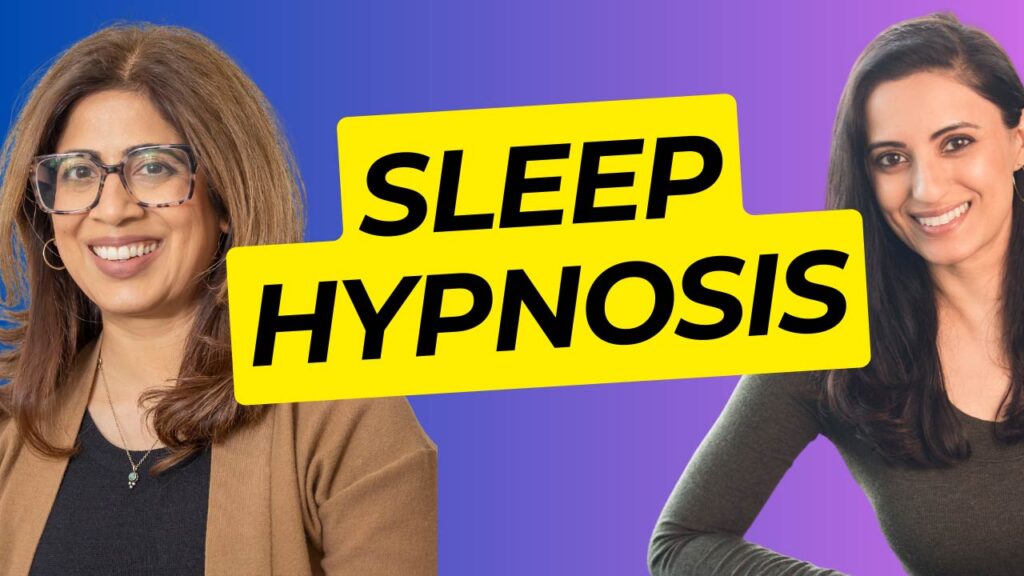
This week, we’re talking about hypnosis with pediatrician Nadia Sarwar MD.
She’s certified in clinical hypnosis and on faculty at the National Pediatric Hypnosis Training Institute. She also runs a private practice providing clinical hypnosis to children and families.
(By the way, these are the kinds of applied, case-based discussions we have inside The Clinical Sleep Kit (CSK) program, where Dr. Sarwar also joins us as guest faculty.)
In this interview, Dr. Sarwar shares:
- Whether hypnosis is evidence-based
- The difference between clinical hypnosis and hypnotherapy
- How hypnosis can support sleep and what her clinical process looks like (some of this surprised me)
- Who is and isn’t a good candidate
- A case example of a 6-year-old with insomnia
- How clinicians can get trained
- And more
If you’re curious about the kinds of interdisciplinary perspectives we explore in CSK, stay tuned. Registration opens again later this month.
Click here to watch the interview and claim your CME credit.
Did you learn something today? Click here to find out how Learner+ can help you meet your evolving educational goals.
P.S. Many clinicians use this CME as a starting point, then continue refining and applying sleep medicine concepts through live, case-based discussion and training inside The Clinical Sleep Kit program.
References:
(1) Olson JA, Stendel M, Veissière S. Hypnotised by Your Phone? Smartphone Addiction Correlates With Hypnotisability. Front Psychiatry. 2020 Jun 25;11:578. doi: 10.3389/fpsyt.2020.00578. PMID: 32670109; PMCID: PMC7330005.
(2) Baselgia S, Rasch B. Hypnotic suggestions in the modulation of sleep. Int Rev Neurobiol. 2025;184:151-178. doi: 10.1016/bs.irn.2025.04.015. Epub 2025 Apr 25. PMID: 41161943.